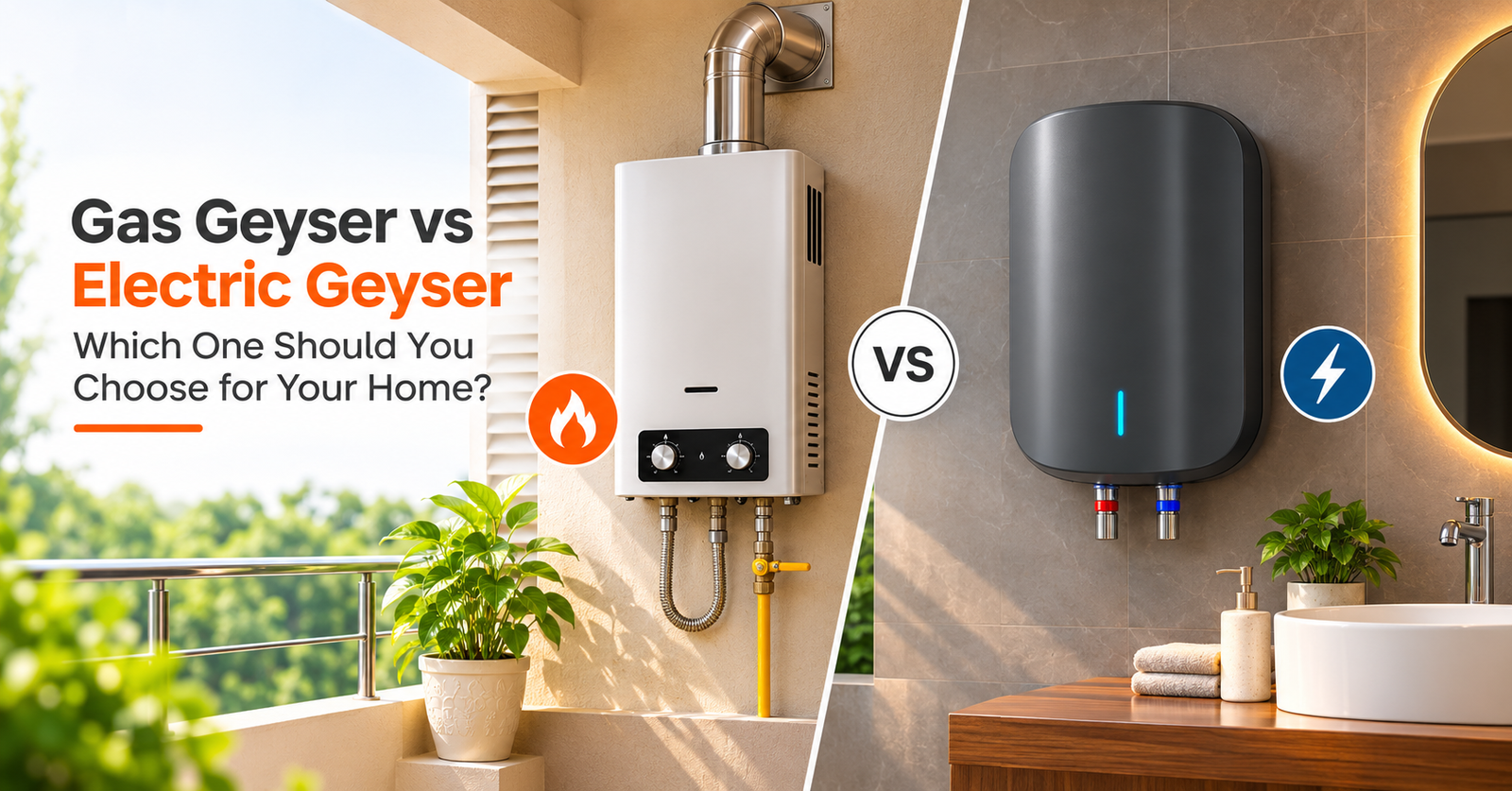
Gas Geyser vs Electric Geyser: Which One Is Right for Your Home?
Short answer: For most Indian homes, especially flats and small bathrooms, an electric storage geyser is the safer and simpler choice. A gas geyser (LPG or PNG) makes sense only if you have open ventilation, a reliable gas supply and frequent power cuts. The running-cost saving from gas is also smaller than most pages suggest, as the worked example below shows.
Most pages on gas geyser vs electric geyser repeat the same line: gas is cheaper to run, electric is safer. Both are true, but neither tells you how much cheaper, or what the safety difference means in a real bathroom. This guide gives you the numbers, the ventilation rules and a clear way to decide. It also covers hotels, hostels and dealers, because their needs are different from a single home’s.
Gas Geyser vs Electric Geyser at a Glance
| Factor | Gas geyser (instant, LPG/PNG) | Electric storage geyser | Electric instant geyser |
| Upfront price | Roughly ₹4,000-5,500 for 6L models | Roughly ₹5,000-10,000 for 15L models | Varies widely by brand and kW |
| Hot water delivery | Almost immediately | 15-25 minutes to heat a full tank | Within seconds of opening the tap |
| Running cost | Usually a little lower | Slightly higher, depends on star rating | Depends on usage and tariff |
| During a power cut | Typically keeps working | Stops | Stops |
| Installation | Gas line, vent and outdoor space | Wall mount and a dedicated circuit | Wall mount and a dedicated circuit |
| Main risk | Carbon monoxide in closed spaces | Shock if earthing is poor | Shock if earthing is poor |
| Best for | Independent homes with open ventilation | Flats, small bathrooms, most families | Single-point use, kitchens, rentals |
Prices are indicative ranges from 2026 listings. They change often, so check current prices before you buy.
How Each Type Works
A gas geyser burns LPG or piped natural gas (PNG) under a heat exchanger. Water heats as it flows, so you get hot water without waiting. Many modern models include a flame-failure device and an oxygen-depletion sensor, but the unit still burns fuel and needs fresh air.
An electric storage geyser heats a tank of water with an element and holds it at a set temperature. Tank quality matters here, which is why glass-lined tanks, anode rods and pressure ratings come up in any serious buying guide. An electric instant geyser heats only the water you use, so it has no standby loss but needs more power at the moment of use.
Gas Geyser vs Electric Geyser Running Cost: The Gap Is Smaller Than You Think
Competitor pages say gas “has lower running costs” and stop there. Here is what that looks like for one bath, using clearly stated assumptions:
- 20 litres of hot water, heated by 30°C (about 25°C to 55°C)
- Electricity at ₹8 per unit
- LPG at ₹900 per 14.2 kg cylinder, with a gas geyser efficiency of about 75%
- About 10% extra loss for an electric storage tank
The heat needed is about 2.5 MJ, or roughly 0.7 kWh. That works out to about ₹5.60 for electricity, or about ₹6.10 with storage losses. For LPG it is about 0.073 kg of gas, or about ₹4.60.
The difference is roughly ₹1 to ₹1.50 per bath. For a family taking 120 baths a month, that is about ₹120 to ₹180. It is real money over years, but it does not justify a riskier setup in a flat. Swap in your own tariff and cylinder price to get your number. A 5-star electric model narrows the gap further because it loses less heat between uses.
Is a Gas Geyser Safe? Bathroom Safety Compared
The two types carry different risks, and each has a clear fix.
Gas geyser: carbon monoxide
When a burner lacks fresh air, it produces carbon monoxide, which is invisible and odourless. A closed, windowless bathroom is the worst place for it. To use a gas geyser safely:
- Install it outside the bathroom, or in a space with permanent ventilation.
- Never run it in a closed bathroom with the door and window shut.
- Use a BIS-certified unit with a flame-failure device, and have a qualified installer fit it.
- Match the gas type: LPG and PNG units are not interchangeable.
- Consider a carbon monoxide alarm if the unit is anywhere near living space.
Electric geyser: shock and pressure
An electric geyser has no combustion, so there is no gas risk. Its risks are electrical, and they are easy to manage:
- Proper earthing and an RCCB/ELCB on the circuit
- An ISI/BIS-marked product on a dedicated, correctly rated circuit with an MCB
- A thermostat set to a sensible temperature, commonly 50-60°C
- A periodic check of the pressure-relief valve
Installation and Hidden Costs
Gas installation costs more than the sticker price suggests. You need a gas line or cylinder space, a regulator, a vent or open area, and a competent installer. In a flat, society rules on gas cylinders can also be a barrier.
Electric installation is simpler, but not free. Budget for a dedicated earthed circuit, an MCB, connecting pipes and a wall that can carry the weight of a full tank. Water quality matters too. In hard-water areas, a glass-lined tank with an anode rod lasts longer, which our guide to the best geyser for home covers in detail.
Which Geyser Is Best for Your Home?
Use the situation, not the brand, to decide:
| Your situation | Better choice |
| Flat or small bathroom with little ventilation | Electric storage |
| High-rise building with high water pressure | Electric storage rated for 8 bar |
| Independent house, open utility space, PNG connection | Gas is a sensible option |
| Frequent or long power cuts | Gas, or an electric geyser with a backup plan |
| Kitchen or single-point hot water | Electric instant |
| Large family with back-to-back baths | Gas, or a larger 25L electric tank |
If you are leaning electric, start with a 15-litre glassline 8-bar storage geyser or a 5-star storage geyser. For a kitchen or a single tap, a 3-litre instant geyser is usually enough. To compare more models on price and warranty, see our list of popular geysers in India.
Gas or Electric Geyser for Hotels, Hostels and Bulk Buyers
Bulk buyers face a different question: not “which is best for one bathroom” but “which is manageable across fifty rooms”.
- Hotels and hostels: Electric storage units are easier to install room by room, easier to service and have no combustion risk in guest bathrooms. Gas suits centralised, high-demand areas such as kitchens and laundries, but needs proper piping, ventilation and compliance with local fire and safety rules.
- Warranty and service: Ask separately about the tank, the heating element and the comprehensive warranty, and who handles service across your locations.
- Dealers and distributors: Gas geysers add installation and safety responsibility. Confirm certification, installer support and returns policy in writing before you stock them. If you want to build a dealer business, see how becoming an authorised Joyonn distributor works.
The geysers we have listed on SmarketOnline are electric storage and instant models from brands such as Crompton. Availability changes, so ask for current stock and dispatch timelines. To request a bulk quotation, share your quantity, city and delivery date.
Common Mistakes When Choosing Between Gas and Electric
- Choosing on running cost alone, without pricing in ventilation and installation.
- Putting a gas geyser inside a closed bathroom “just for convenience”.
- Buying by wattage or litres instead of tank type, pressure rating and warranty.
- Skipping the earthing and RCCB check on an electric geyser.
- Ignoring the building’s water pressure and the local water hardness.
Frequently Asked Questions
Which is better, a gas geyser or an electric geyser?
For most Indian flats and small bathrooms, an electric storage geyser is better because it is safer and easier to install. A gas geyser can work well in an independent home with open ventilation and a reliable gas supply.
Is a gas geyser cheaper to run than an electric geyser?
Usually yes, but by a small margin. In the worked example above the difference is roughly ₹1 to ₹1.50 per bath, and it shifts with your electricity tariff and gas price.
Is it safe to use a gas geyser in the bathroom?
Only with strong ventilation, and it is safest installed outside the bathroom. In a closed bathroom a gas geyser can produce carbon monoxide, which is invisible and odourless.
Can a gas geyser work without electricity?
Typically yes, because most use battery or spark ignition, so they keep working during power cuts. Check the ignition type of the model you buy.
Which geyser is best for a flat or apartment?
An electric storage geyser, because it needs no gas line or vent. In a high-rise, choose a unit rated for 8-bar pressure.
Which is better for hotels and hostels?
Electric storage geysers are generally easier to install and service room by room. Gas suits centralised, high-volume uses if proper piping, ventilation and safety compliance are in place.
Which geyser is best in an area with hard water?
A glass-lined electric tank with a sacrificial anode rod is a practical choice, as it resists corrosion and scale better than an unprotected tank.
Ready to Choose?
Compare the electric models above, or tell us your city, bathroom setup and budget and we will help you shortlist. For hotels, hostels and dealers, request a bulk quotation through SmarketOnline.
6. FAQ Section
These are the same 7 FAQs that appear in the article.
- Which is better, a gas geyser or an electric geyser?
For most Indian flats and small bathrooms, an electric storage geyser is better because it is safer and easier to install. A gas geyser can work well in an independent home with open ventilation and a reliable gas supply.
- Is a gas geyser cheaper to run than an electric geyser?
Usually yes, but by a small margin. In the worked example above the difference is roughly ₹1 to ₹1.50 per bath, and it shifts with your electricity tariff and gas price.
- Is it safe to use a gas geyser in the bathroom?
Only with strong ventilation, and it is safest installed outside the bathroom. In a closed bathroom a gas geyser can produce carbon monoxide, which is invisible and odourless.
- Can a gas geyser work without electricity?
Typically yes, because most use battery or spark ignition, so they keep working during power cuts. Check the ignition type of the model you buy.
- Which geyser is best for a flat or apartment?
An electric storage geyser, because it needs no gas line or vent. In a high-rise, choose a unit rated for 8-bar pressure.
- Which is better for hotels and hostels?
Electric storage geysers are generally easier to install and service room by room. Gas suits centralised, high-volume uses if proper piping, ventilation and safety compliance are in place.
- Which geyser is best in an area with hard water?
A glass-lined electric tank with a sacrificial anode rod is a practical choice, as it resists corrosion and scale better than an unprotected tank.